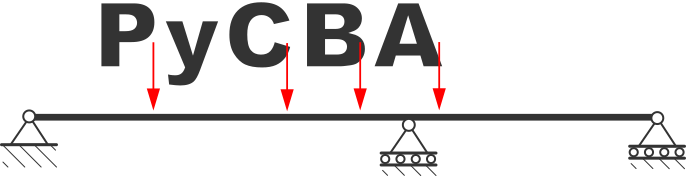






Welcome to PyCBA’s documentation!#
PyCBA is a focused, dependable 1-D continuous-beam engine built on the matrix (direct)
stiffness method — fast, exact, and a pleasure to use, with light dependencies (numpy / scipy /
matplotlib). It is deliberately not a general 2-D/3-D FE package; instead its analysis core
powers a surprisingly broad toolkit for the design, assessment and teaching of buildings and
bridges.
Analysis. Continuous beams of any number of spans with pin / roller / fixed / spring and
rotational-spring supports, prescribed settlements and internal hinges; an element library of
Euler–Bernoulli, Timoshenko (shear-deformable), non-prismatic (variable EI) and
Winkler-foundation members; nonlinear elasto-plastic analysis to collapse; and
free-vibration (modal) analysis.
Loads & bridges. UDL, point, partial, trapezoidal, moment and imposed-curvature (creep / shrinkage / thermal) loads, load cases and combinations; moving-load bridge assessment with influence lines, envelopes, coincident effects and shear points; and built-in code load models, road & rail, from six nations (HL-93, LM1 / LM71, HB, CL-625, JTG, Cooper E, M1600 / 300LA, T44 / MS18).
Visualisation. Beam and load schematics (matplotlib and publication-quality TikZ /
stanli), shaded result diagrams, reaction / coincident-effect / mode-shape /
collapse-mechanism / vehicle plots, an interactive Plotly backend, and selectable display
unit systems.
Contents:
- Installation
- Tutorials
- Introduction to PyCBA
- Visualisation
- Load Cases, Load Patterning & Design Envelopes
- Influence Lines
- Bridge Analysis
- The Vehicle Library
- Nonlinear Beam Analysis
- Non-prismatic Elements
- Timoshenko (Shear-Deformable) Beam Elements
- Beam on an Elastic (Winkler) Foundation
- Creep, Shrinkage, and Thermal Analysis
- Free-Vibration (Modal) Analysis
- Defining Beams
- API Reference
- Theoretical Basis
- Sign conventions and degrees of freedom
- Elements
- Global stiffness matrix
- Loads
- Stability / mechanism detection
- Boundary conditions
- Solution and reaction recovery
- Member results: moment, shear, rotation and deflection
- Linear superposition, load cases and patterning
- Free-vibration (modal) analysis
- Nonlinear analysis — Generalized Clough model
- References
- Matrix (direct) stiffness method and beam elements
- Consistent nodal loads (fixed-end forces)
- Non-prismatic (variable-\(EI\)) elements and imposed curvature
- Timoshenko (shear-deformable) beam elements
- Numerical integration
- Stability / mechanism detection
- Nonlinear analysis and plastic-hinge models
- Plastic analysis (virtual work / collapse load factors)
- Bridge loading and moving-load analysis
- Prestressed concrete and equivalent loads
- Differential temperature (thermal effects)
- Beams on elastic foundations