The Vehicle Library#
VehicleLibrary is a repository of standard bridge design vehicles, grouped by region. Each getter returns a Vehicle (a set of axle point loads) ready for a BridgeAnalysis:
cba.VehicleLibrary.AU.get_m1600(6.25)    # AS 5100.2 road
cba.VehicleLibrary.US.get_hl93_truck()     # AASHTO LRFD
cba.VehicleLibrary.EU.get_lm71()           # Eurocode rail
The regions are AU (AS 5100.2 / NAASRA), US (AASHTO / AREA Cooper), EU (Eurocode EN 1991-2), UK (BS 5400 / CS 454), CA (CSA S6) and CN (JTG D60).
Where a code pairs the vehicle with a lane (distributed) load, that intensity is noted in the getter’s docstring and applied through BridgeAnalysis.run_load_model(..., w_lane=) (see the last section).
Use cba.plot_vehicle(vehicle) (or vehicle.plot()) to sketch a vehicle’s axle loads.
[1]:
import numpy as np
import matplotlib.pyplot as plt
import pycba as cba
VL = cba.VehicleLibrary
Australia — AS 5100.2 and the historical NAASRA models#
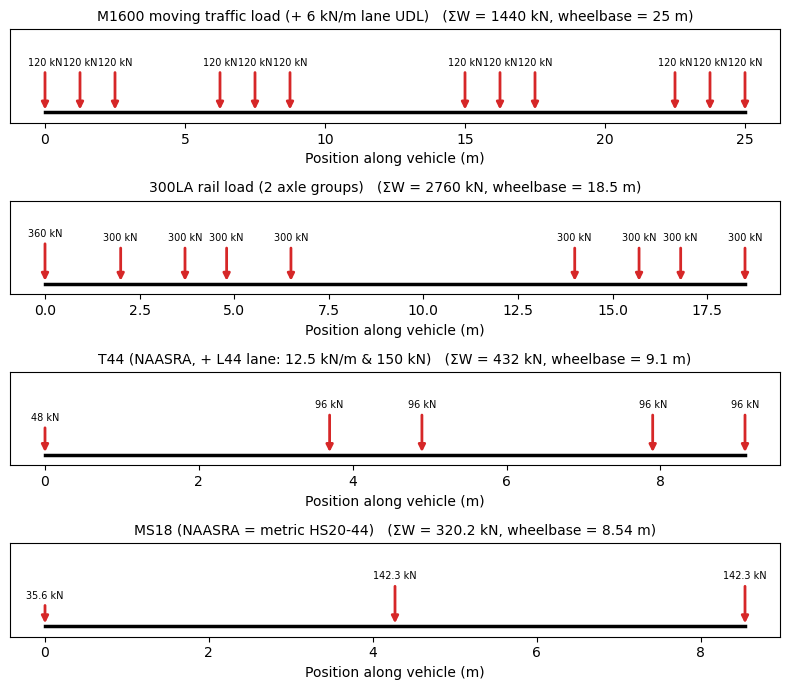
VL.AU carries the current AS 5100.2 models (M1600, S1600, A160, W80, 300LA / LA rail) and the historical NAASRA road trucks (T44, MS18), plus the ABAG assessment vehicles.
[2]:
fig, axs = plt.subplots(4, 1, figsize=(8, 7))
cba.plot_vehicle(VL.AU.get_m1600(6.25), ax=axs[0], title="M1600 moving traffic load (+ 6 kN/m lane UDL)")
cba.plot_vehicle(VL.AU.get_300la(axle_group_count=2), ax=axs[1], title="300LA rail load (2 axle groups)")
cba.plot_vehicle(VL.AU.get_t44(), ax=axs[2], title="T44 (NAASRA, + L44 lane: 12.5 kN/m & 150 kN)")
cba.plot_vehicle(VL.AU.get_ms18(), ax=axs[3], title="MS18 (NAASRA = metric HS20-44)")
fig.tight_layout()
United States — AASHTO LRFD and the AREA Cooper rail series#
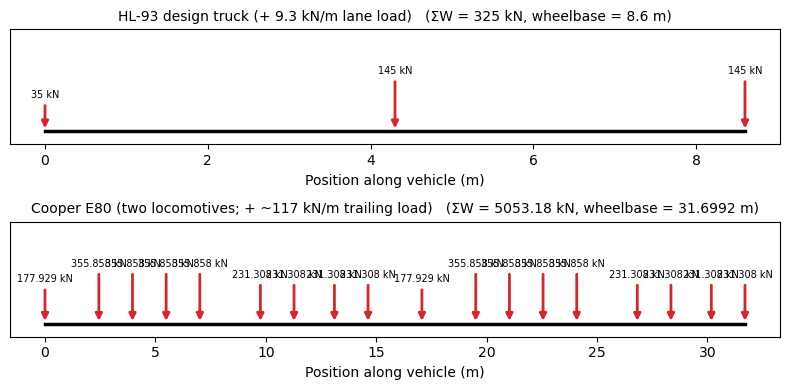
VL.US carries the HL-93 design truck and tandem, and the Cooper E-series rail load (two locomotives, scaled by the E-number).
[3]:
fig, axs = plt.subplots(2, 1, figsize=(8, 4))
cba.plot_vehicle(VL.US.get_hl93_truck(), ax=axs[0], title="HL-93 design truck (+ 9.3 kN/m lane load)")
cba.plot_vehicle(VL.US.get_cooper(80), ax=axs[1], title="Cooper E80 (two locomotives; + ~117 kN/m trailing load)")
fig.tight_layout()
Europe — Eurocode EN 1991-2#
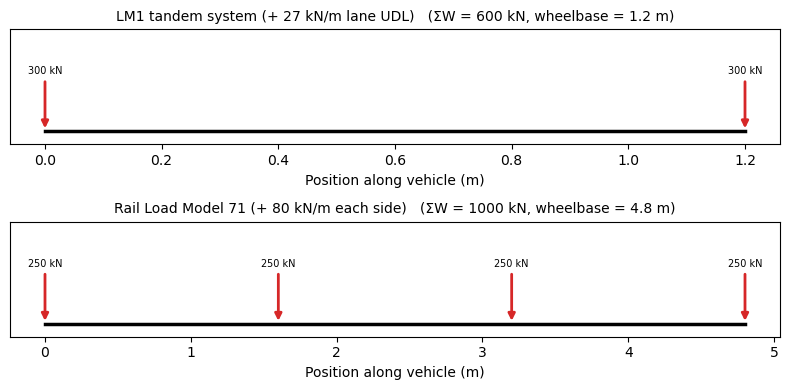
VL.EU carries the Load Model 1 tandem system (road) and rail Load Model 71.
[4]:
fig, axs = plt.subplots(2, 1, figsize=(8, 4))
cba.plot_vehicle(VL.EU.get_lm1(), ax=axs[0], title="LM1 tandem system (+ 27 kN/m lane UDL)")
cba.plot_vehicle(VL.EU.get_lm71(), ax=axs[1], title="Rail Load Model 71 (+ 80 kN/m each side)")
fig.tight_layout()
UK, Canada and China#
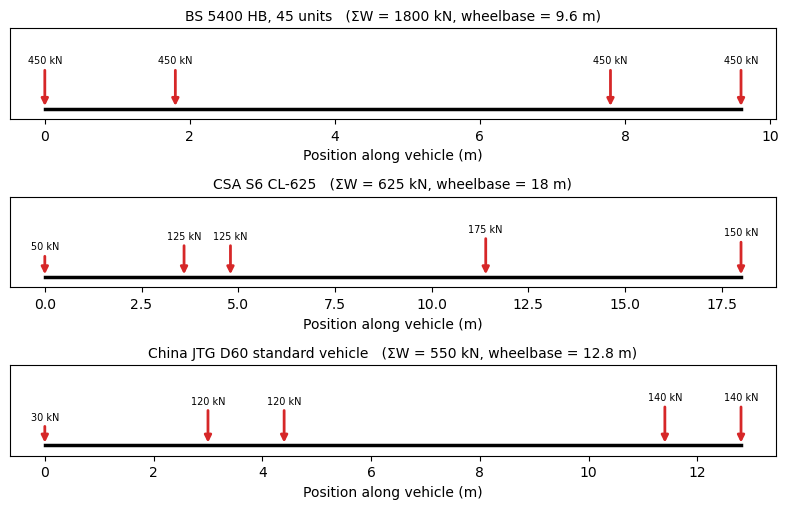
VL.UK (BS 5400 / CS 454 HB), VL.CA (CSA S6 CL-625) and VL.CN (JTG D60 standard vehicle).
[5]:
fig, axs = plt.subplots(3, 1, figsize=(8, 5.2))
cba.plot_vehicle(VL.UK.get_hb(units=45), ax=axs[0], title="BS 5400 HB, 45 units")
cba.plot_vehicle(VL.CA.get_cl625(), ax=axs[1], title="CSA S6 CL-625")
cba.plot_vehicle(VL.CN.get_jtg_vehicle(), ax=axs[2], title="China JTG D60 standard vehicle")
fig.tight_layout()
Using a model in an analysis#
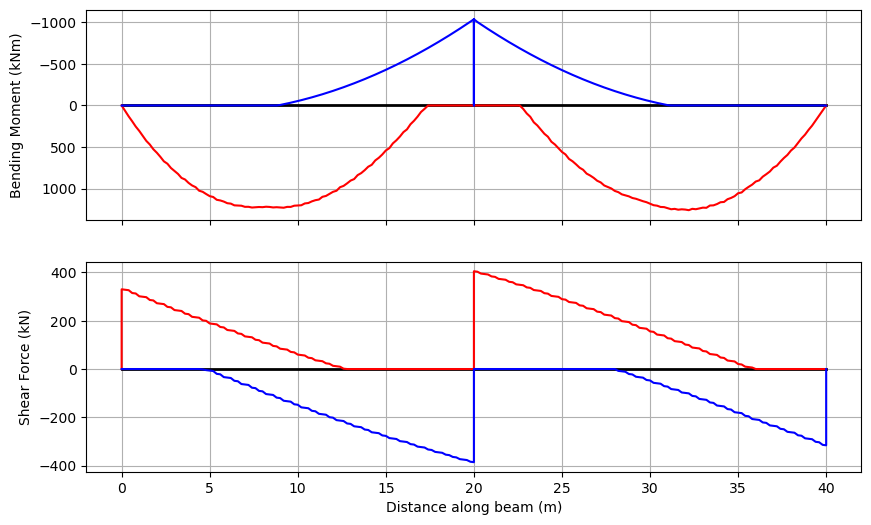
Pass a vehicle to BridgeAnalysis. For a code model that pairs the truck with a lane load, use run_load_model(step, w_lane=...) — here the HL-93 truck with its 9.3 kN/m design lane load over a two-span continuous bridge, enveloped over the traverse.
[6]:
ba = cba.BeamAnalysis([20.0, 20.0], 1.0e7, [-1, 0, -1, 0, -1, 0])  # EI in kN.m^2
bridge = cba.BridgeAnalysis(ba, VL.US.get_hl93_truck())
env = bridge.run_load_model(step=0.5, w_lane=9.3)   # HL-93 truck + design lane load
env.plot()
print(f"max sagging moment   = {env.Mmax.max():8.1f} kN.m")
print(f"max hogging moment   = {env.Mmin.min():8.1f} kN.m")
max sagging moment   =   1259.0 kN.m
max hogging moment   =  -1036.5 kN.m
Companion lane loads (summary)#
Several models are defined as a vehicle plus an accompanying lane/distributed load; pass it as run_load_model(..., w_lane=):
Model |
|
Note |
|---|---|---|
|
6 |
continuous under the truck |
|
24 |
stationary load |
|
12.5 |
L44, also a 150 kN concentrated load |
|
9.3 |
design lane load |
|
≈ 1.46·E |
trailing uniform load |
|
27 |
Lane 1 UDL (9 kN/m² × 3 m) |
|
80 |
each side, beyond the axles |
|
9 |
with 80%-reduced axles |
For models with a variable axle spacing (get_hl93_truck, get_t44, get_ms18, get_hb, get_m1600/get_s1600), pass the spacing that produces the worst effect.